Key takeaways
- Abstract art communicates through color, line, shape, texture and composition.
- Slow down: spend at least a minute with a painting before deciding what you think.
- Notice your own response. It's not a test with a right answer.
- Titles and the artist's story are invitations, not instructions.
"I don't get abstract art" is one of the most common things people say in galleries. Here's a secret: there's nothing to "get" in the way there is a puzzle to solve. Abstract painting is closer to music than to a story. You experience it.
What abstract art is (and isn't)
Abstract art doesn't try to depict the visible world realistically. Instead, it uses the building blocks of painting directly: color, line, shape, texture and composition. Some abstract paintings begin from something real, like a landscape or a memory, and simplify it. Others are entirely invented. Both can be deeply expressive.
A five-minute way of looking
- First impression (10 seconds). What's your gut reaction? Calm, excited, uneasy, joyful?
- Color (1 minute). Which colors dominate? Are they warm or cool? Where do colors meet, and do they clash or blend?
- Movement (1 minute). Where does your eye go first, and where does it travel next? Are the lines calm, sweeping, jagged?
- Surface (1 minute). Look from the side. Is the paint thin and glassy, or thick with impasto? Can you see how it was applied?
- Return (1 minute). Look at the whole again. Has your first impression changed?
Five questions to ask any abstract painting
- How does it make me feel, physically?
- What does it remind me of, even loosely?
- What is the strongest contrast in the painting?
- Where is it busy, and where is it quiet (negative space)?
- Does the title change what I see?
Try it: The Conversation
Look at The Conversation. Two forms face each other across a dark divide: one warm and layered in crimson and rose, the other cool, pale and spattered with ink. Many people see two profiles; others see two hearts or two worlds. Notice how the black divide isn't empty. It holds tension, the space where something passes between them. That's abstract art working: no literal scene, but a clear human experience.
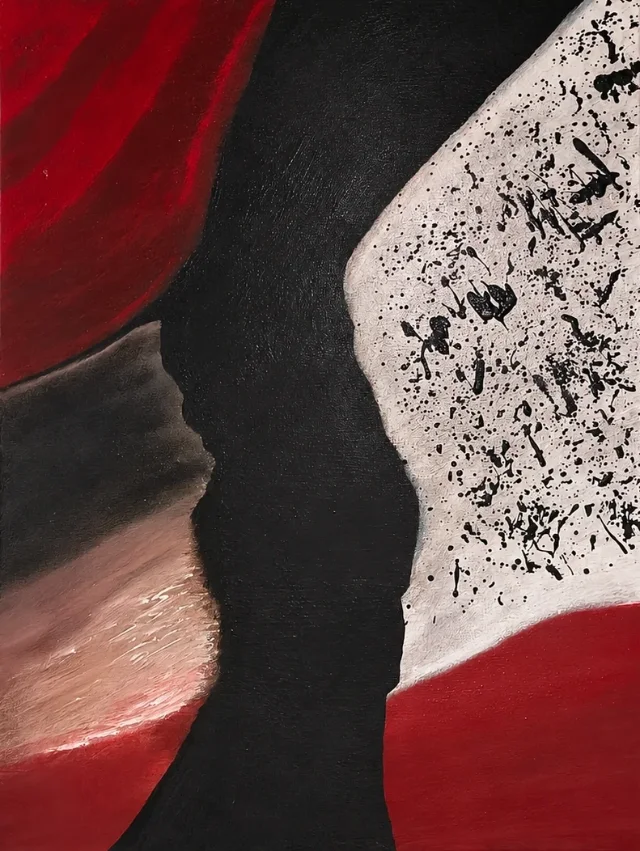 Original paintingThe ConversationAcrylic on canvas, 18 × 24 in · $180
View the painting →
Read the marks
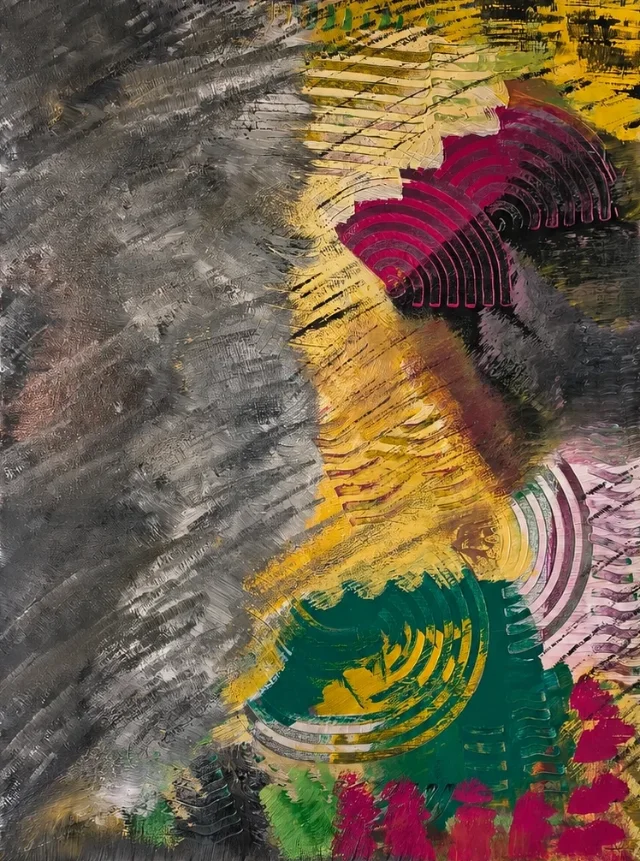
In abstract painting, how paint is applied is part of the meaning. Fast, gestural strokes record energy and motion. Slow, thin glazes create stillness and depth. Combed ridges create rhythm. These marks are the artist's handwriting.
A little context helps
Abstract art has a rich history, from early twentieth-century pioneers such as Wassily Kandinsky (who connected painting to music) to abstract expressionism and color field painting in mid-century America. You don't need the history to enjoy a painting, but it can deepen the experience.
The artist's intent, and yours
An artist's statement or title offers one doorway in. Svitlana Morhunov, for instance, describes her paintings as meditations on light, faith and home, shaped by her training in music. But once a painting hangs in your home, your experience of it matters just as much. Read more about how music shapes her work and spirituality in abstract art.
Frequently asked questions
Is abstract art meant to have a meaning?
Often, yes, but not always a single literal one. Many abstract paintings express a feeling, an idea or an experience. Your own response is a valid part of the meaning.
Why is abstract art so expensive if it looks simple?
Simplicity is often hard-won. Balancing color, composition and texture so a painting feels resolved takes years of practice, and many layers that you may not see directly.
What's the difference between abstract and abstract expressionism?
Abstract art is the broad category of non-representational art. Abstract expressionism is a specific movement from mid-century New York, known for gestural painting and large color fields.